
Systems Integration
Systems integration connecting enterprise applications, telecom platforms and operational infrastructure through documented integration architecture and delivery.
Systems integration is the process of linking disparate enterprise applications, telecom platforms and operational infrastructure so they share data and work as a single, coherent system rather than a collection of isolated parts — and to be clear before anything else: Kronix Telecom is an enablement and integration partner that works with the mobile operators; we are not a licensed carrier. We architect and deliver that integration layer for banks, government, and enterprise across Ghana and Togo, since 1995. Request a proposal — or discuss an integration project: +233 20 531 3333.
What Is Systems Integration?
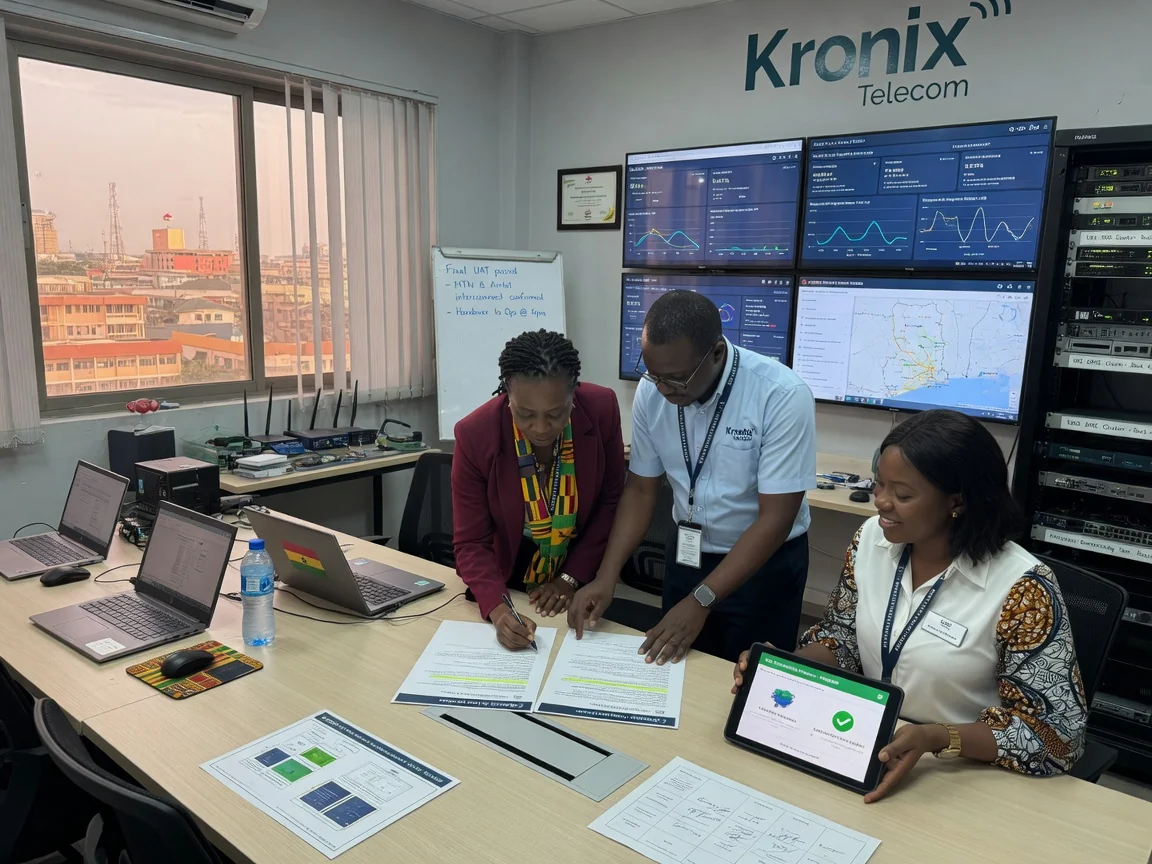
Systems integration is the discipline of connecting enterprise applications, telecom platforms and operational infrastructure into a unified, coherent architecture — ensuring that disparate systems communicate reliably, data flows without friction and operational workflows execute without manual intervention at the seams.
For banks, mobile network operators, government agencies and large enterprise operations across Ghana and Togo, systems integration is not a convenience — it is a foundational requirement. Where a core banking platform must exchange instructions with a VAS middleware layer, where a government service portal must communicate with a telco’s USSD gateway, or where an enterprise ERP must synchronise with field operations infrastructure, the integration layer is what determines whether the institution functions as a single organism or a collection of isolated parts. Kronix Telecom architects and delivers that layer.


When to Specify Systems Integration
Systems integration becomes critical at the point where an institution’s growth, regulatory obligation or operational modernisation outpaces its current architecture. Telcos expanding VAS platform capability, banks deploying mobile money or SMS notification infrastructure, government agencies connecting citizen-facing digital services to backend records systems, and large enterprises consolidating multi-site operations onto a managed platform — each of these scenarios demands disciplined integration architecture before deployment proceeds.
In the Ghana and Togo institutional market, the most consequential integration projects arise during platform migrations, new product launches requiring third-party API connectivity and regulatory-compliance deployments that mandate audit-ready data flows. These are not projects that accommodate ambiguity. Every connection point must be documented, every handover signed off, every failure mode anticipated in advance.
Methodology — The Kronix Telecom Specialist Approach
-
Integration Scoping and Architecture Review — Specialists conduct a structured discovery of all platforms, APIs, data schemas and operational workflows requiring connection. A formal integration architecture document is produced before any configuration begins.
-
Interface Mapping and Dependency Analysis — Every integration point is mapped: upstream and downstream dependencies, data transformation requirements, authentication protocols and failure-path behaviour. Nothing is assumed; everything is documented.
-
Staged Configuration and Sandbox Validation — Integration builds are executed in a controlled staging environment. Each connection is validated against defined acceptance criteria before it touches a live operational system.
-
Controlled Production Migration — Go-live is executed in a phased sequence with rollback protocols defined in advance. Cutover activities are documented at every handover stage to ensure continuity of accountability.
-
Post-Integration Verification and Handover — Following production deployment, a formal verification cycle confirms that all integrated systems are performing to specification. Documentation packages are issued to the client’s technical and compliance teams.
Platforms, Protocols and Integration Standards
- Enterprise API and middleware connectivity — REST, SOAP and proprietary telco protocol bridges
- VAS platform integration including USSD, SMS gateway, airtime and data service layers
- Core banking and payment platform connectors aligned to institutional security requirements
- ERP and operational system integration across multi-site enterprise environments
- Data integrity controls and audit-trail documentation at every integration handover
- End-to-end testing frameworks with structured sign-off criteria before production deployment
Outcomes and Service Assurance
A well-executed systems integration engagement eliminates the operational fragility that arises when platforms are connected informally or without architectural discipline. Institutions that commission integration through a structured, documented methodology gain operational continuity, reduced incident surface area and a clear audit trail that satisfies both internal governance and regulatory review.
Kronix Telecom’s process-led delivery model means that every project concludes with a verified, documented integration architecture — not a verbal understanding. Ongoing managed services are available where clients require post-deployment monitoring, incident management and platform maintenance across connected systems in Ghana and Togo.
How We Work & To Standard
- We operate as an enablement and integration partner within Ghana’s NCA-regulated telecom framework, working with the licensed mobile operators — we are not an MNO/carrier and do not claim a network licence we do not hold
- Vendor-neutral integration to recognised practice — we describe only the partnerships and accreditations we actually hold
- Every engagement concludes with a verified, documented integration architecture, not a verbal understanding
- Established 1995 — a real enterprise-connectivity and VAS enablement and integration partner
What It Costs — Honestly
A systems integration engagement is scoped and quoted as a proposal — the number of systems, the integration complexity, the protocols involved, and whether ongoing managed support is required all drive it, so there is no flat published rate. We quote against your actual requirement, never an invented figure.
Related Services
- Enterprise Connectivity Solutions — the managed network the integration depends on
- Managed Network Services — ongoing operation of integrated platforms
- VAS Platform Enablement — where integration underpins service activation
- Enterprise Connectivity & VAS in Ghana — the full enablement picture
Related Sectors and Solutions
- VAS Platform Enablement — where integration architecture underpins service activation and billing workflows
- Enterprise Connectivity — managed network infrastructure that integration architecture depends upon
- Managed Network Services — ongoing operational support for integrated platform environments
Frequently Asked Questions
What is systems integration? The discipline of connecting disparate enterprise applications, telecom platforms and operational infrastructure into one coherent architecture, so systems communicate reliably and data flows without manual intervention at the seams.
Is Kronix Telecom a mobile network operator? No — we are an enterprise connectivity and VAS enablement/integration partner that works with the licensed operators. We are not an MNO/carrier.
Which platforms do you integrate? Enterprise APIs and middleware, VAS/USSD/SMS gateway layers, core banking and payment connectors, and ERP and operational systems — documented at every handover.
What does it cost? Scoped and quoted as a proposal against your actual requirement — no flat published rate.